Zarahemla
Book of MormonZarahemla functions as one of the Book of Mormon’s principal centers of settlement, political authority, and historical memory. Its significance lies not simply in being a named land or city, but in the way it gathers displaced peoples, receives inherited records, and becomes a stage on which identity is repeatedly rebuilt after migration, conflict, and divine judgment.
Origins and Setting
Zarahemla is associated with a people who came out of Jerusalem at the time Zedekiah, king of Judah, was carried captive into Babylon. This origin gives Zarahemla a diasporic foundation: its population is connected to the same Jerusalemite past that structures the histories of Lehi, father of Nephi, and his descendants, yet it develops as a distinct community in the promised land. The settlement therefore stands as a geographical expression of survival through displacement rather than as an untouched continuation of Jerusalem.
The wider geography of Zarahemla is defined in relation to the lands of the Nephites and the Lamanites. A major line ran from east to west and divided the Lamanites from the Nephites, placing Zarahemla within a contested regional order rather than an isolated kingdom. The land’s position made it both a home and a frontier: migration routes, political boundaries, missionary journeys, and military pressures repeatedly converged around it.
Peoples, Records, and Political Formation
The history of Zarahemla is inseparable from the movement of peoples through the wilderness. Groups undertook further journeys into the wilderness and, in another migration, gathered their families, flocks, and herds before departing their land. These movements show Zarahemla’s world as mobile and unstable. Communities were not defined only by fixed territory; they carried kinship, livestock, religious commitments, and records across changing landscapes, making settlement a continuing process of collective negotiation.
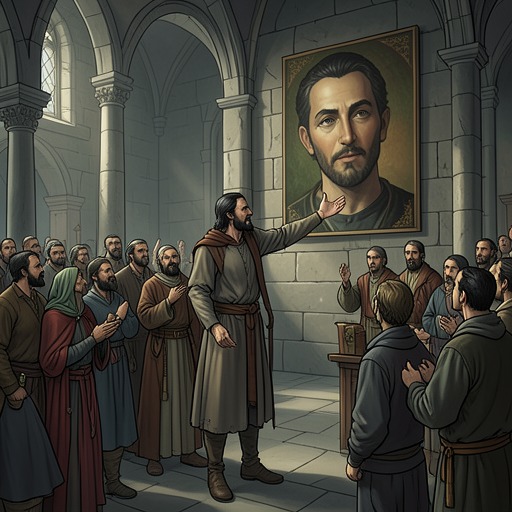
Mosiah I discovered the people of Zarahemla and found that they had preserved a connection to Jerusalem’s past. Their encounter enabled a political and cultural consolidation that placed the community within the larger Nephite historical framework. Zarahemla thus becomes a meeting point between separate migrations: the people of Lehi, father of Nephi, and the people already established in the land. Its identity is consequently composite, formed through discovery, incorporation, and the preservation of ancestral memory.
The Book of Mormon itself presents this history through layered records and abridgments. The record is described as an abridgment of the records of the people of Nephi and the Lamanites, written for the Lamanites as a remnant of the house of Israel and also for Jew and Gentile. It also incorporates an abridgment from the record of the people of Jared, whose language was confounded while they built a tower toward heaven. Zarahemla therefore belongs to a narrative geography much larger than its immediate political boundaries: its history is placed alongside the histories of Jerusalem, the Jaredite dispersal, and the future gathering of Israel.
A Center of Power and Vulnerability
Zarahemla is repeatedly linked with the organization of Nephite public life. The book of Mosiah follows the political world in which kingship, succession, contention, and the possibility of war shape the future of the people. Concerns about appointing another ruler include the danger that a claimant might become angry, draw away part of the people, and cause wars and contentions. In this setting, Zarahemla represents the concentrated political space where authority can preserve unity but can also magnify division.
The city and land are therefore marked by a structural tension. They offer the advantages of central organization, inherited law, and collective identity, yet the concentration of power makes them vulnerable to succession disputes and factional separation. The narrative’s movement from royal rule toward a more distributed political order is not merely constitutional change; it reflects the problem of how a migrant people can preserve unity without allowing inherited authority to become a source of renewed conflict.
Migration, Mission, and Reconfiguration
Zarahemla’s surrounding lands serve as a base from which people move outward for religious and political purposes. When Ammon and the other Sons of Mosiah arrived among the Lamanites, they separated and departed one from another, trusting in the Lord while declaring the word of God. Their departure turns the regional geography into a network of crossings: Zarahemla is connected to the borderlands not only by commerce or war but also by missionary movement and the attempt to alter relations between historically opposed peoples.
Other migrations move in the opposite direction. The people of the Lord gathered their families, flocks, and herds and departed their land into the wilderness. Such episodes reveal a recurring pattern in which land is relinquished in order to preserve a community. Zarahemla’s importance is consequently measured less by permanence than by its capacity to receive, organize, and remember populations whose relationship to territory has been interrupted.
Covenant Geography and Narrative Significance
The book’s larger purpose is to show the remnant of the house of Israel the great things the Lord has done for their fathers and to teach that they are not cast off forever. It also seeks to convince Jew and Gentile that Jesus Christ is the Eternal God manifesting himself to all nations. Within that framework, Zarahemla becomes a material setting for a theology of historical continuity: migrations do not erase covenant identity, and political collapse does not exhaust the meaning of a people’s past.
This significance extends into the book’s prophetic horizon. Jesus Christ declares that the Lord will establish his people, and that a time will come when the fulness of the gospel will be preached to them. Zarahemla is thus part of a geography that moves from ancestral departure through settlement and division toward restoration and gathering. Its repeated associations with records, migration, boundary, authority, and judgment make it a model of the book’s central pattern: a people survive by carrying memory through upheaval, and a land becomes meaningful when it is continually reinterpreted through covenant, loss, and renewal.